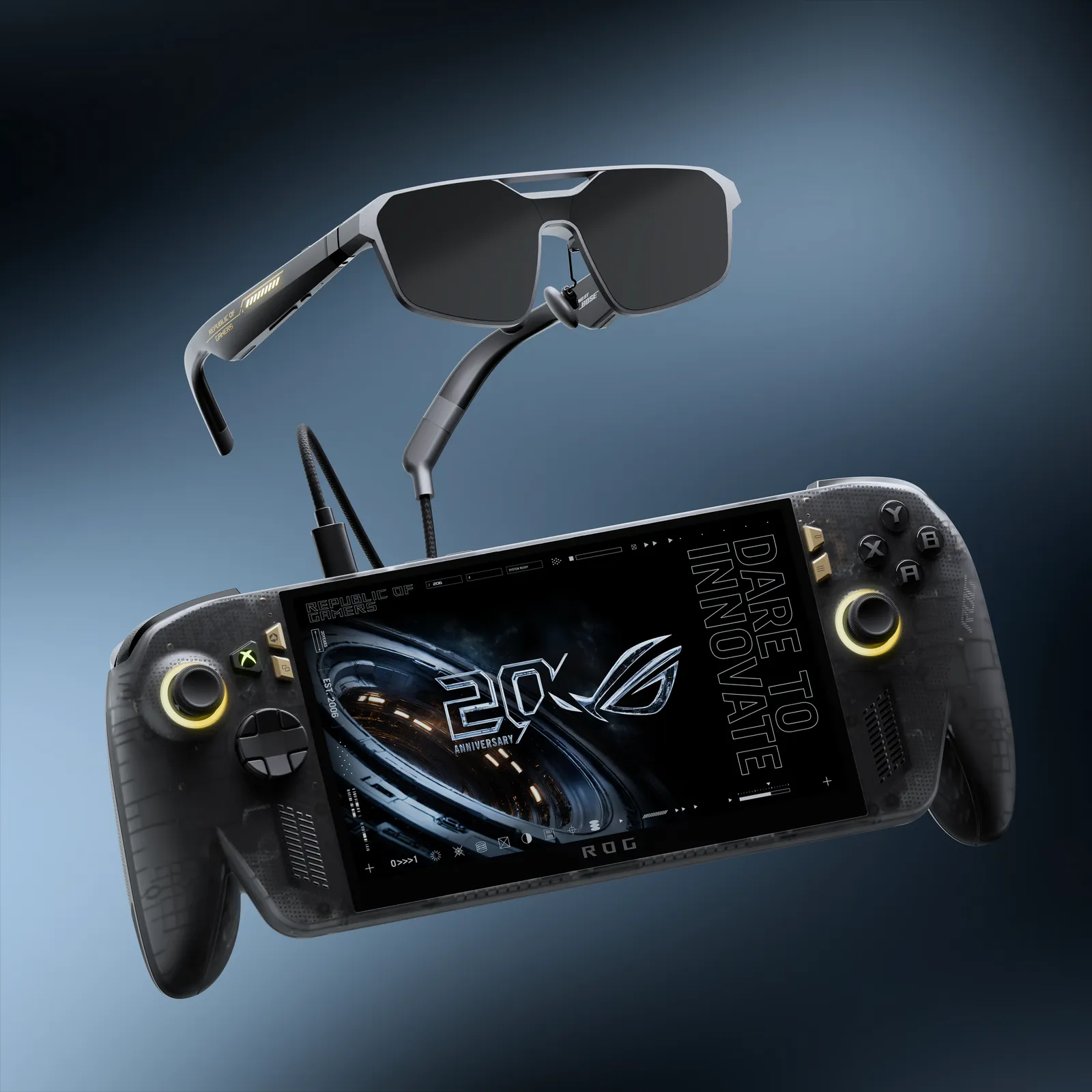
ASUS launched the ROG Xbox Ally X20 on October 15. It’s a 20th-anniversary edition of its Xbox-branded handheld, with a translucent black shell, gold accents, and the upgrade Ally fans have wanted for years: an OLED screen.
It costs $1,299. The regular ROG Xbox Ally X is still on sale at $999. So the real question is whether a better screen and some control tweaks are worth $300 when the hardware inside is the same.
For most people, they aren’t. If you care a lot about how games look on a handheld and you don’t already own a good one, they might be. We haven’t used the X20. This piece is based on ASUS’s specs and what reviewers have said so far.
Price, bundles and availability
ASUS sells the X20 on its own for $1,299 (listed at $1,299.99 on the ASUS Store). There’s also a $2,499 bundle that adds ROG XREAL R1 Edition 20 AR glasses, a custom dbrand Killswitch case and a Pelican protector case.
In the US, it’s available now from the ASUS Store and Best Buy. ASUS says the Xbox Ally ($599) and Xbox Ally X ($999) stay on sale at their original prices, so the X20 sits on top of the lineup rather than replacing anything.
What’s actually different
The screen is the headline. Here’s how the X20 compares with the Xbox Ally X, based on ASUS’s official specs:
- Screen: The X20 has a 7.4-inch OLED panel at 1920 x 1080 and 120Hz. ASUS rates it at 600 nits typical and 1,400 nits peak, with VESA DisplayHDR True Black 1400 certification and VRR from 30Hz to 120Hz. The Ally X uses a 7-inch IPS-level LCD, also 1080p and 120Hz, rated at 500 nits.
- Chip: Both use the AMD Ryzen AI Z2 Extreme. It’s the same processor.
- Memory and storage: Both have 24GB of LPDDR5X RAM and a 1TB M.2 2280 SSD.
- Battery: Both have an 80Wh battery.
- Weight: The X20 weighs 756g, compared with 715g for the Ally X.
- Controls: The X20 adds magnetic TMR thumbsticks, which ASUS says are designed to reduce stick drift, plus a D-pad that switches between four-way and eight-way, flush-sitting face buttons and rubberized grips.
- Cooling: ASUS says it redesigned the fans and airflow, and claims 20% more overall airflow.
That’s the whole list. There’s no performance upgrade. Stuff’s review puts it plainly: the X20 has “essentially the same hardware as the regular Asus Xbox ROG Ally X.”
What reviewers are saying
Reviewers mostly agree on two points. The screen is excellent, and the price is hard to justify.
- Stuff gave it 4 out of 5. It called the OLED “the main event” and described the X20 overall as “a real heart-over-head purchase.” In its testing, Stuff got about 125 minutes of Cyberpunk 2077, compared with about an hour and a half from the LCD Ally X under its settings.
- PC Gamer said the X20 is “as bougie as the $300 price bump implies.” Its reviewer called it “the best ROG Ally on the market right now” but added that it is “certainly not the best value.”
- XDA Developers called it the reviewer’s “favorite handheld I’ve ever used.” It also said it isn’t “a worthwhile purchase if you already own an Xbox Ally X, unless you really care about an OLED screen.”
- Tom’s Guide, in a comparison piece, reported that the X20 lasted just shy of three hours in its gaming battery rundown test.
Several reviewers also point out that pricier Intel Arc G3 handhelds, such as the MSI Claw 8 EX AI+, beat it on raw performance. Stuff and PC Gamer both raise this.
X20 vs Steam Deck OLED
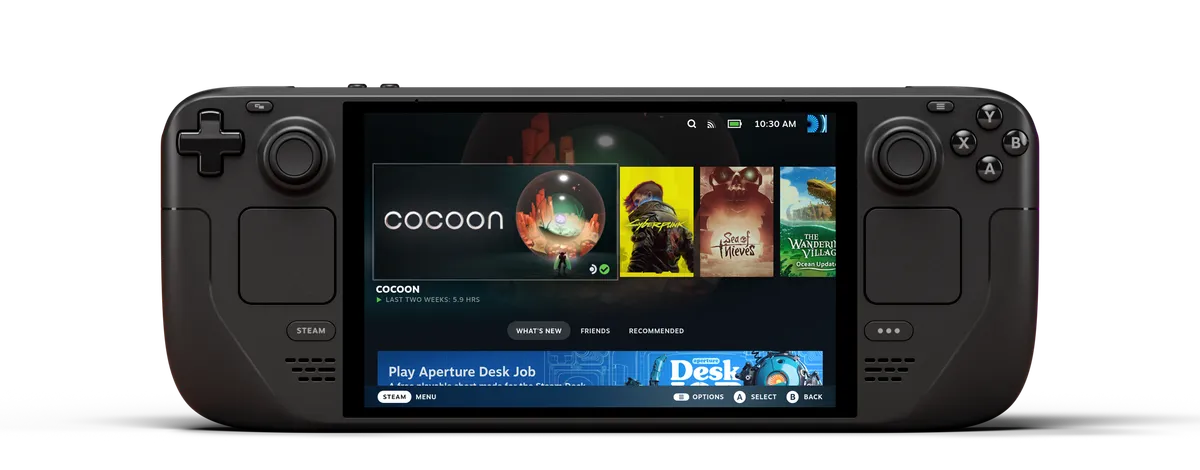
The Steam Deck OLED is the obvious comparison, since it was the handheld that made OLED screens a selling point.
- Price: Valve raised the Steam Deck OLED’s prices in May, citing memory and storage costs. It’s now $789 for 512GB and $949 for 1TB, according to Gematsu and Tom’s Hardware. That makes the X20 $350 more than the 1TB Deck.
- Screen: Both are 7.4-inch OLEDs. Valve’s specs list the Deck at 1280 x 800, up to 90Hz, with 1,000 nits peak HDR brightness. The X20 runs at 1080p and 120Hz, and ASUS rates it at 1,400 nits peak.
- Software: The Deck runs SteamOS. The X20 runs Windows 11 with Microsoft’s full-screen Xbox experience. Stuff notes the Windows approach means you won’t run into games whose anti-cheat software blocks SteamOS. It also says Windows still isn’t quite as slick as SteamOS on a handheld.
On paper, the X20 has the sharper, faster and brighter screen. The Deck costs less and runs a smoother handheld OS. Stuff still calls the Deck OLED the value pick, saying it “continues to hold the value crown, even after a price hike of its own.”
Who should upgrade
Xbox Ally X owners: Mostly skip it. You’d pay $1,299 for the same chip, RAM, storage and battery. The screen is better, but the games will run the same. XDA’s reviewer made the same call.
Steam Deck OLED owners: Also mostly skip it. You already have an OLED handheld. The X20’s sharper 1080p, 120Hz panel and Windows access are real advantages, but $1,299 is a lot to pay for a sideways move.
Owners of an older LCD handheld (the original ROG Ally, an LCD Steam Deck, or similar): This is where the X20 makes the most sense, if you want Windows and Xbox features and the screen matters to you.
First-time buyers: If you want the best-looking Windows handheld ASUS makes, the X20 is it. If you care more about value, the $999 Ally X gets you the same performance, and Tom’s Guide points to the $599 Xbox Ally as the budget option.
Our take
The OLED is the X20’s only real upgrade, and on its own it isn’t worth $300 to most people. If you already own an Xbox Ally X or a Steam Deck OLED, keep it. If you’re buying your first serious handheld, you want Windows, and you’ll notice a better screen every time you play, the X20 is a reasonable splurge. Just know you’re paying for looks and feel, not speed.
FAQ
Is the ROG Xbox Ally X20 faster than the Xbox Ally X? No. Both use the AMD Ryzen AI Z2 Extreme with 24GB of RAM and 1TB of storage, according to ASUS.
How much is the ROG Xbox Ally X20? It’s $1,299 on its own, or $2,499 in a bundle with ROG XREAL AR glasses and cases.
Is the X20’s screen bigger than the Ally X’s? Yes. It’s 7.4 inches versus 7 inches, and it’s OLED rather than LCD. Both run at 1080p and 120Hz.
Is the X20 better than the Steam Deck OLED? Its screen has a higher resolution and refresh rate, and it runs Windows. The Steam Deck OLED is cheaper, starting at $789, and reviewers like Stuff still see it as the better value.
Sources
- ASUS press release: ROG Xbox Ally X20 availability (October 15, 2026, via GlobeNewswire)
- ASUS Pressroom: ROG Xbox Ally X20 announcement
- ASUS: ROG Xbox Ally X20 product page
- ASUS: ROG Xbox Ally X (2025) tech specs
- Stuff: Asus ROG Xbox Ally X20 review (October 16, 2026)
- PC Gamer: Asus ROG Xbox Ally X20 review
- XDA Developers: Asus ROG Xbox Ally X20 review
- Tom’s Guide: ROG Xbox Ally X20 vs MSI Claw 8 EX AI+
- Valve: Steam Deck OLED tech specs
- Gematsu: Steam Deck OLED price increase announced (May 27, 2026)
- Tom’s Hardware: Valve hikes Steam Deck OLED prices